Mother opossum entrapped for days
Today we received a call about an opossum that was causing quite a disturbance at a home in Watsonville. The resident explained how the animal was getting inside a converted garage - now used for storage, and pulling things off shelves and defecating all over the place. At the time of the call they said they could see the animal tucked back on a shelf sleeping, and it looked like there were a couple of young ones.
Evolution of a barn owl nest box
By Rebecca Dmytryk
Creating a safe and sound environment for barn owls to raise their young has been, and I suspect it will continue to be, a journey of its own.
Teco & Lotte
Welcome to the Teco and Lotte Chronicles... In December, 2016 we installed a barn owl nest box at the Haute Enchilada in Moss Landing California - part of the restaurant owner's commitment to sustainable practices and environmental stewardship. A pair of resident barn owls took to the box quickly. By January, the first egg was laid. Check back for frequent updates and happenings inside the nest. View the live stream on YouTube at Teco & Lotte.
Barn Owl Nest Boxes - Size Matters
To those who build and/or install or promote barn owl nest boxes,
This is a request to come together and agree on minimum overall size requirements and entry hole dimensions and placement.
PRODUCT REVIEW: Crenova iScope Waterproof Inspection Camera
By Rebecca Dmytryk
In our line of work, sometimes we need to inspect inside walls or other inaccessible spots to locate trapped or nesting animals. The Crenova iScope was recommended by a colleague, and seems to be a decent tool for the job, and, at $20.00 on Amazon - you just can't beat the price.
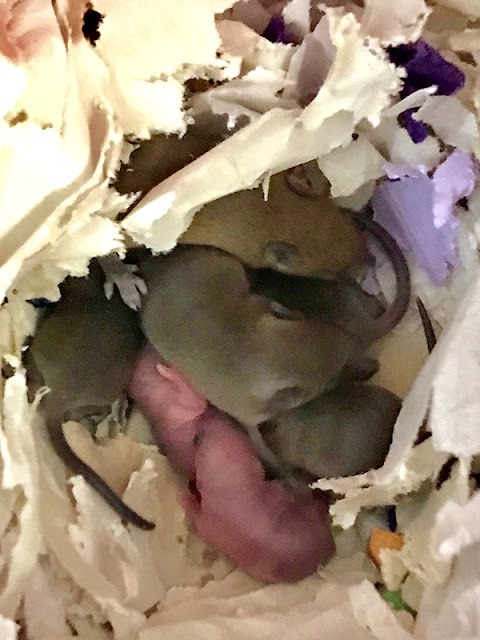
Mouse in the house
I just have to share good moments, working with people who share our compassion for animals.
This morning, one of our clients called to give me an update. We'd rodent-proofed their home over a week ago, sealing up all the gaps and possible intrusion points and making sure there weren't any large animals living under the home.
DIY humane rat and mouse eviction
Ridding one's home of mice and rats can be a bit labor intensive, frustrating at times, but, once completed, the home should be rodent-free for many, many years.
The following post describes how to protect your home from rats and mice, for good, without using poison or other lethal means.
A picture worth a thousand words
This picture was sent to us by someone worried about a coyote in their neighborhood.
Do you see what this is?
It's a coyote suffering from mange - an infestation of mites has caused the animal to lose fur and break out in sores. The coyote's ears indicate how cold and miserable it feels.
Look what it's standing next to. A poison bait station for rodents.
Perhaps the coyote is waiting for its next meal - another poison-laced mouse or rat.
Could this be the cause of this poor animal's failing condition?
Opossum in a garage...
Today we were called out to remove an opossum that had found its way into a garage, squeezing under a slight opening under the front door.
It had made itself at home, probably venturing out during the night to do its 'possum-thing, eating slugs and snails and foraging for other edibles, which, unfortunately too often, includes pet food left out overnight.
What do you think about coyotes in Laguna Beach?
There's a proposed plan before the City of Long Beach to increase trapping and killing of coyotes - blanket trapping in early spring to kill the pregnant females, and in fall to kill off the young of the year.
Apparently, this plan was offered by Animal Pest Management - a pest control company that had been contracted with the city for its services but has since (a week or so ago) been terminated. The city replaced APM with Critter Busters.
Long Beach Coyotes
By Rebecca Dmytryk
![]() |
| Image by Dru Bloomfield |
Over the last few months, a group of Long Beach residents have become very vocal about the presence of coyotes in their neighborhoods, demanding coyotes be trapped and killed. It seems to be a relatively small group of individuals from two Facebook groups, Coyote Watch Long Beach and Coyote Watch Garden Grove, who have, since 2013, been leading a campaign to force state and local government to eradicate coyotes.
Mother raccoon moves out during the day
Today, we went to work on a home in Pacific Grove, shoring up all the vents except for one so the mother raccoon inside could still come and go. The next step would be to apply a repellent barrier with a certain mix of essential oils to encourage her to move her babies to another location. Sometimes we install an electronic device in the crawlspace to add pressure.
Well, today, we didn't need to do any of that. The mother raccoon was so upset by us working around the exterior of her "den", that she decided to move one of her babies while we were on site.
Her intrusion point was above a window on the second floor, with very poor gripping points, so we placed two ladders to help her out, literally. Check out the footage:
Well, today, we didn't need to do any of that. The mother raccoon was so upset by us working around the exterior of her "den", that she decided to move one of her babies while we were on site.
Her intrusion point was above a window on the second floor, with very poor gripping points, so we placed two ladders to help her out, literally. Check out the footage:
Abandoned Magpie ducks
This weekend we collected two domestic ducks that had been abandoned at Westlake Park in Santa Cruz. The ducks were not being maintained - fed a proper diet, and they were aggressive towards wild waterfowl.
On our initial visit to assess the situation, we found the two black and white ducks together, foraging along the shoreline of the small lake. From their coloration and upright carriage, we believe they are Magpies - a fairly unusual breed of domestic duck.
The Magpie duck is believed to have originated in Wales in the early 1900s, and was first imported to the United States in 1963.
The two ducks were a bit skittish, as though they had been chased, or perhaps someone had tried to capture them unsuccessfully. It took a few days before we were able to collect them.
They were transported to the local animal shelter where they will be fed and cared for until they are adopted.
Magpies are a hardy variety of domestic duck, living approximately 9-12 years. They are good layers, producing over 220 eggs annually and they are active foragers, eagerly consuming slugs and snails and insects. A great addition to a home farm.
Quiet restored
This week, HWC was called to collect two un-owned Indian peafowl from a quiet residential area in the hills above Soquel, CA.
The Indian peafowl is found in the drier lowland areas of Sri Lanka on the Indian subcontinent. It has been introduced to many parts of the world by collectors and often, as in this case, they are allowed to roam freely, establishing feral populations.
The two males - one white and the other sporting the standard metallic blue-green colors, wandered into the rural subdivision a few weeks ago, and stayed. With their loud calls at dawn and a bad habit of hopping onto parked cars, their presence soon became a nuisance.
![]() |
| Just captured - Mary and Barbara hold on tight to the peacock as it's carried to the transport vehicle. |
On Monday, we successfully captured the larger peacock. The younger, white peafowl was more skittish and elusive.
Yesterday, however, we were able to bait the bird close enough to capture.
The birds were transported to Santa Cruz County Shelter where they will be available for adoption.
Take the Coyote Challenge!
By the time we're contacted, a coyote has often become a problem - there's been a loss or there's fear of an imminent attack. The animal is a perceived threat that must be removed without delay.
When it comes to coyotes, we find people are usually set in their misbeliefs and are far less willing to change their habits than with other species - less willing to adapt to living with these animals as part of their environment, less willing to invest in making modifications to their property even if that is what will solve the problem, yet, they are often quite demanding that something be done, admonishing local officials for not taking action to protect their home, family and pets.
For these people, we offer the Coyote Challenge.
The Coyote Challenge is our pushback to those who believe nothing less than lethal control will work. The Coyote Challenge is also a way for us to help those who truly cannot afford to invest in non-lethal control measures.
In return, participants agree to share their account of the process - and the results - which we expect will be that their coyote problem has been resolved, for good.
With each challenge being documented from beginning to end, we see this as a great opportunity to help people and coyotes while gathering conclusive evidence that non-lethal control methods do work.
The Coyote Challenge officially launched last month and we have 3 applications in the review process.
We will be donating our time but supplies, equipment and associated travel costs will be covered through a fund that has been set up through Wildlife Emergency Services.
To apply for help through the Coyote Challenge, email help@humanecontrol.com or call 855-548-6263. Click the Donate button below if you'd like to contribute toward the fund that offsets the cost of equipment and such.
So, this skunk walks into an office and...
This morning we were called about a skunk that was seen inside an office building.
It wondered inside the building through a door that was left open and then apparently lost its way within the labyrinth of cubicles.
It took shelter in a corner office.
Workers closed the door and posted warning signs.
When we arrived, we found the adult skunk tucked back behind a large work station. The animal was bright and alert but unwilling to budge from its corner hiding spot.
We decided to hold off until nightfall when the skunk would be more apt to move.
Meanwhile, workers offered to bring in large sheets of plywood to build a corridor leading from the back corner office through the building to the closest exit. A good plan!
Duane and I returned after dark to find the plywood in place, creating a clear passage to the outside, but the skunk was still in its hiding spot.
Skunks can be very stubborn and difficult to move. Why should they comply, right?
Skunks will tolerate an extreme amount of quiet nudging and poking and prodding without giving an inch. But air - breath - can sometimes get animals to move on.
We decided to give that a try rather than risk more aggressive tactics. We rigged a delivery system using a very long piece of thin plastic tubing - like you'd find at an aquarium store, and we attached it to a strip of wood.
Duane positioned the tip of the tube at the skunk's lower back region and gave it a little puff.
Without lifting its tail, the skunk moved forward about three feet.
After a few seconds, another puff of air sent the skunk out from behind the unit - it shot out of the office, down the corridor and out through the open doors. YES!
Outside, the skunk seemed to know right where it was as it shimmied through openings in a fence and off into the night where it belonged.
Check out the video:
Nesting mallard at Wells Fargo

This week we received a call regarding a duck acting aggressively at a Wells Fargo near Watsonville, CA. We went to check it out and, sure enough, a mallard hen was nesting in the planter at the entrance to the bank.
We advised the bank manager that we were not allowed to remove the duck or harm her nest, but we could place a blind to shield her from disturbances and help protect patrons.
Lion Lights
Check out this amazing video about a young man's invention that saved his family's cattle and lions' lives!
Here's his Ted Talk:
Mother of Five Evicted
When Duane and Rebecca of Wildlife Emergency Services aren't out rescuing animals on their own time and dime, they're busy helping resolve human-wildlife conflicts - which helps support their charitable endeavors.
One recent job involved a mother raccoon - a mother of five, that took up residency in the space between the bathtub and walls of a home in Freedom, CA.
The babies were placed in a large cardboard box insulated with balled-up newspaper, and the box was set right by the main access to under the house - the one the mother raccoon used nightly.
There, Duane installed a one-way door to allow the raccoon to get out, but prevented her from re-entering.
Check out the video of the eviction process:
That night, the family watched as the mother raccoon came for each of her babies, and carried them off to an alternate den site.
Raccoons are amazing creatures. If you haven't seen this PBS program, Raccoon Nation, be sure to. It will open your eyes to the unique and amazing world of the raccoon!
Raccoon Evicted
A mother of four was evicted from her home in Santa Cruz, CA, yesterday.
The raccoon mother had been observed under a house near Twin Lakes State Beach, in Santa Cruz.
After donning protective clothing, Rebecca entered the crawlspace where the mother had been seen. She found the nest, cautiously gathered the babies into a sack, and shuttled them out. They were placed in a box insulated with newspaper to keep them warm.
Next, Duane attempted to chase the mother out from under the building. It worked!
After exiting, the mother raccoon stayed nearby, hiding under the deck. Cries from her babies were used to draw her to the reunion box.
One of the cubs was placed out in the open for her to retrieve - she quickly gathered up the crying infant and carried it off to another den site.
The remaining three babies were left inside the reunion box and set near where the raccoon had been entering.
By early evening she had reclaimed all but one, then, sometime during the night she came back for the last one. Success.
We want to thank the homeowners for calling Humane Pest Control and for allowing us to solve their wildlife problem safely and humanely.
Check out the video.
Gulls
![]() |
| Duane Titus mounts a bird deterrent on a rooftop to discourage gulls. |

This week, Duane installed some devices on a rooftop in Pacific Grove to deter gulls from loafing and nesting there.
When he first climbed onto the roof, an adult Western gull landed on the chimney and watched.
Gulls are very intelligent birds and have adapted well to urban environments. Check out THIS article on herring gulls in the UK.
![]() |
| Gull standing next to plastic owl meant to scare them off. |
The Wildlife Intrusion Delusion
It's that time of year, again. We're just a few weeks away from the birthing season for urban wildlife, like squirrels, skunks and raccoons.
Before it's too late, homeowners should have one last look around their property for signs of unwanted guests, because, once babies arrive, getting rid of the animals becomes much more difficult. Not impossible, just a lot more work!
Signs of an intrusion include ripped siding, pulled back screens, missing vents, and holes leading under a structure's foundation.
If openings are found, residents should not seal up the gaps, as this risks entombing animals inside, but instead, contact a professional company that will focus, not on the animals, but their access points.
The animals are not the problem, they are a symptom.
The real problem is the reason the animals have invaded, which is either food, shelter, or both. When we take these things away, the animals leave.
There will always be squirrels, skunks, opossum, raccoon and coyote residing in or near populated areas.
That's why trapping and killing wild animals is not a long-term solution.
Trapping is an outdated practice that removes a few individual animals, but does nothing to permanently solve the problem.
Even if they were all eradicated at once, more would come, as the urban landscape is a niche - a modern ecosystem that can support a number of wild creatures, and therein lies the key - how many?
Urban wildlife populations can be controlled sustainably by limiting their access to food and shelter. For example, shoring up holes in buildings, making sure garbage bins are shut, and that no pet food is left outside.
For those with small pets or livestock, their enclosures must be built, not to keep them inside, but designed to keep predators out.
If communities would make a concerted effort to do these things, they would surely see a reduction in wildlife conflicts. Trapping, though, is not the answer, for many reasons.
In California, relocating trapped wildlife is prohibited. Relocation spreads disease among wild populations, and research has shown that many relocated animals meet their demise as they try to return home.
Lethal control will be futile, though, and in some cases - like with coyotes, it can cause a species to have greater and larger litters.
What is effective in protecting people, their pets and their property, is working with resident animals to solve specific problems permanently.
Sustainable methods include eviction and exclusion from structures, aversion systems, and use of non-harmful repellants.
In and around the Bay Area there are only a handful or service providers, specializing in non-lethal wildlife control, including A Wildlife Exclusion Service, serving Sonoma and Napa counties, WildCare Solutions in Marin, and Humane Pest Control, serving the Peninsula and the East Bay, south, including Monterey County and portions of Los Angeles.
These businesses can be contacted directly or through our California wildlife referral hotline at 1-866-WILD-911, extension 2.
In the meantime, for residents who locate a breach in their home, like a broken subfloor vent, we have a simple method to confirm the presence of a nocturnal animal and a trick to getting them to move on. Give us a call at 855-548-6263 for a visit or over-the-phone consultation to receive this information.
Please note, in California, anyone trapping 'nuisance' wildlife must comply with applicable local and state regulations. Traps must bear a number or identifying mark registered with the Department of Fish and Wildlife (Title 14 CCR Section 465.5 f 1). A person proposing to set a trap within 150 yards of a habitable dwelling (other than their own), must first acquire written consent of those surrounding homeowners (Title 14 CCR Section 465.5 g 3). Traps must be inspected and animals removed at least once in 24 hours.
It is not enough that someone is annoyed with wildlife on their property, they must show damage to crops or property before fur-bearers or non-game mammals may be taken under Fish and Wildlife Code 4152, and then, only the animal(s) causing the damage may be taken - non-target animals that are inadvertently trapped must be released.
Trapping is not the answer!
Bat Exclusion
On March 3rd, Duane and I started a bat exclusion job. It was a big job, so we took it a section at a time.
First, Duane patched a few possible entry points inside the home, then we focused on the back porch, patching holes and installing exclusion devices.
We had to get a bit creative because we were working with rounded surfaces.
I configured a couple of cone shaped funnels that seemed to do the job - the bats came out at night and couldn't get back inside.

Thankfully, we're working for wonderful people who appreciated their resident bats, just not inside their house. They were very willing, though, to let the bats have their own home.
Duane installed a large bat house purchased from HouseForBats.com - very well constructed and built using specifications set by Bat Conservation International.
On our next visit we removed the exclusion devices and patched the hole, permanently sealing the entrances. Check out the before and after shots below.
![]() |
| Before. |
![]() |
| After. |
Squirrel Family Evicted
Duane had to get really creative with this one. After making sure all other entrances were sealed, he installed a tiny one-way door. It worked! Squirrel family evicted. Success!
Squirrel Eviction and Reunion
Colleagues in Washington D.C. perform a humane eviction of a mother squirrel and her babies. Watch the excellent video below.
Great job by Humane Wildlife Services!
Stowaway raccoons!
Yesterday, Duane and Rebecca responded to a call about a litter of raccoons that were found in the storage compartments of a boat located in Santa Cruz, CA.
Raccoon Eviction and Reunion
![]() |
| Four baby raccoons in their reunion box. |
Subscribe to:
Posts (Atom)
A sweet story
We just had to share this sweet story from one of our customers. We love working with people who share our compassion for animals, no matte...
-
We just had to share this sweet story from one of our customers. We love working with people who share our compassion for animals, no matte...
-
By Rebecca Dmytryk Creating a safe and sound environment for barn owls to raise their young has been, and I suspect it will continue ...
-
By Rebecca Dmytryk In our line of work, sometimes we need to inspect inside walls or other inaccessible spots to locate trapped or nesting...